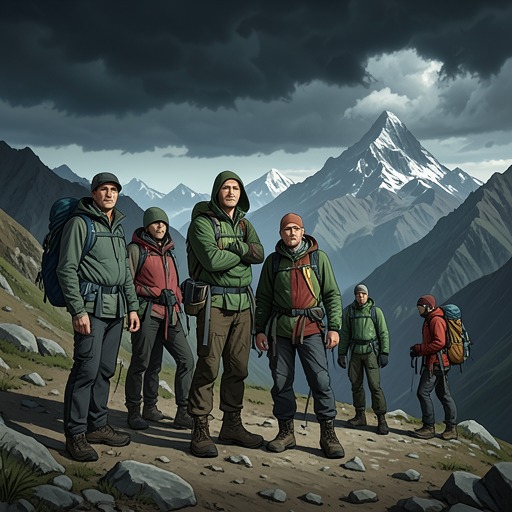
IMAX·IWERKS expedition’s retreat from its summit attempt
The ClimbThe IMAX/IWERKS expedition’s retreat from its summit attempt was a deliberate decision to descend from Camp III rather than climb toward the summit in unstable weather. On the morning of May 9, 1996, David Breashears and Ed Viesturs judged that the wind meant the expected weather window had not arrived. Their choice to wait, despite the pressure of seeing other teams ascend, makes the episode a clear contrast between patience and forward momentum on Everest.
A summit plan put on hold
The IMAX/IWERKS team had intended to climb before the Mountain Madness and Adventure Consultants teams, partly because its filming plans called for a relatively empty summit ridge. Viesturs explained that the team also wanted to avoid sharing the ridge with roughly forty other climbers. The schedule therefore joined a cinematic aim to a safety concern: climbing a day earlier seemed to offer both a less crowded setting for filming and less congestion on the route.
On May 7, while the Fischer and Hall teams spent the night at Camp II, the IMAX/IWERKS climbers were already at Camp III, preparing to make their summit bid on May 9. But the wind persisted through the night and was still blowing high on the mountain when they woke. Breashears and Viesturs concluded that conditions did not match the weather window they were waiting for. They had time, Viesturs recalled, and decided to descend and let the teams below make their climb before returning when the weather was more stable.
The encounter with Boukreev
As the IMAX/IWERKS climbers descended, they met Anatoli Boukreev ascending toward Camp III. Viesturs told him that his team was coming down because it disliked the unstable weather and planned to wait several days to see whether conditions improved. The exchange was cordial: they shook hands, greeted each other, and wished one another well.
The encounter exposed the emotional cost of a decision that was clear in principle but uncomfortable in company. Viesturs remembered feeling somewhat sheepish as other climbers headed up with smiling faces while his group went down, and wondering whether they had chosen correctly. They nevertheless held to their judgment. As Boukreev watched the IMAX/IWERKS climbers continue downhill, the Hall and Fischer teams were moving up toward a summit attempt two days away. The same mountain thus held two competing readings of the moment: one team saw reason to wait; the others continued toward their planned climb.
Patience against momentum
The retreat did not mean that the IMAX/IWERKS team had abandoned its summit objective. Viesturs said the team had time to return and intended to climb when the weather was more stable. Its decision was a postponement based on conditions, not a renunciation of the goal. That distinction gives the episode its force: the climbers had reached a high camp and were positioned to attempt the summit, yet they chose to give up that immediate opportunity rather than treat the schedule as decisive.
The contrast also clarifies the expedition’s different priorities. The IMAX/IWERKS team wanted a quiet ridge for filming and judged the wind unsafe for its attempt; the Fischer and Hall teams were already committed to climbing toward the summit. When Boukreev met Viesturs, the weather was fair at their point on the route, but that did not resolve the question of conditions higher up. Viesturs’s report concerned the instability above, and his team’s choice rested on what it had experienced at Camp III, not on the brief circumstances of the meeting.
Significance in the wider climb
The retreat stands as a counterpoint to the summit bid that followed. It makes visible that the climbers’ decisions were not simply stages on one shared ascent: teams could read the same developing weather differently, and a summit plan could be revised even when others pressed on. Viesturs and Breashears accepted the awkwardness of descending against the direction of the crowd rather than let that crowd determine their judgment.
The episode is also a concise example of the value of waiting in a high-risk climb. The IMAX/IWERKS team had a filming rationale for seeking a less crowded ridge, but neither that aim nor the effort already invested compelled it to proceed in wind it considered unstable. Its decision preserved the possibility of a later attempt while refusing to make the planned date an obligation. Against the ascent of the Fischer and Hall teams, the team’s retreat records a different kind of commitment: not to reach the summit at the earliest opportunity, but to wait for conditions it considered acceptable.